Sunday, December 5, 2004

What Does A Hid Ballast Do

Muddy Water: end!

Sorry for the long silence due to some personal problems ... Good news though

side aqua: clear my water has returned!
treatment by black had a significant effect on pea puree initial (problem green water). But I was still far from normal water clarity.


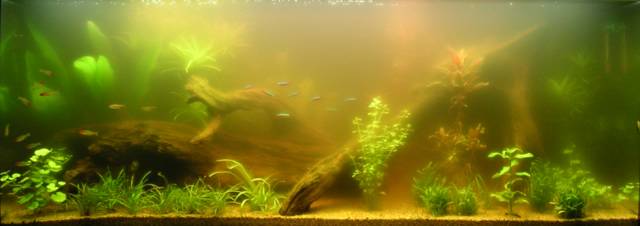
02/11/2004:
8 weeks after the impoundment.

07/11/2004: 9 weeks after the impoundment.

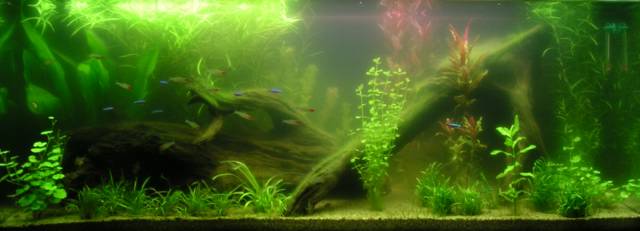
09/11/2004: after two days of carbon filtration.

17/11/2004: a notable achievement after two days of complete darkness.

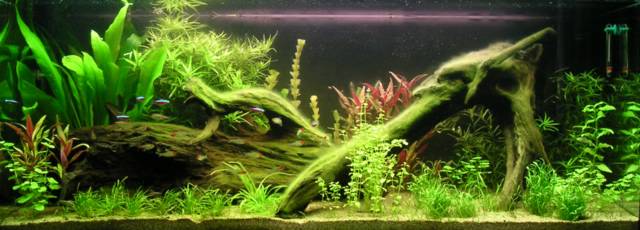
05/12/2004: clear water ... again!

How did I get to eliminate the problem completely ?
In fact, I do not know! ;)
Certainly the addition of several solutions.

First, I reduced the lighting in my T5, which - for now - is the designated culprit behind the proliferation of algae. Complete stop at first, then use 4 hours per day and 6 hours per day currently.

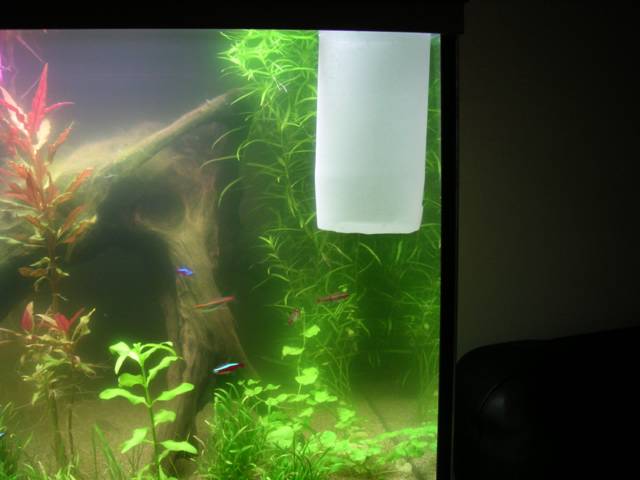
I completed a natural way: using Daphnia. These little creatures are feasting unicellular algae and I have been advised to be very effective. Only fish eat daphnia! As it was not possible for me to leave the fish, so I cobbled together a kind of shark cage for my little worker with a plastic cylinder made from a Coke bottle and a sock filter. Sylvain gave me a small initial colony (thank you to him). After a few days, swarmed into the cage! During that time, the water cleared up. Then the colony was absorbed as the water cleared up yet.


Seen from above: the sock is simply attached to a corner of the tray.

Seen from the front: the exchange takes place from the bottom.

Finally, I recently introduced in my filter sepiolite clay (kitty litter), which seems to clarify the ownership of water (like charcoal) and which I read a possible effect on green water. It was more trying than anything else. In any case, the result is there.

Throughout this period, I made water changes eventually moderate (20 and 25%), but I finely filtered with JBL SymecMicro changed regularly. I also tested

CO2 craft in recent weeks but this is not supposed to affect green water.

I do not cry victory right away: I prefer to watch it closely for some time yet. But I am still very happy with the current results. Go for fun, I commend you! ;)


05/12/2004: clear water ... again!

whole story:
- J + 9 weeks! cloudy water!
- Muddy Water (continued)
- Muddy Water (continued again ...)
- Muddy Water: end!

Wednesday, November 17, 2004

Writing Court Community Service Letter

Muddy Water (continued again ...)

Diagnosis my cloudy water was slow but it now seems certain: this is a unicellular algae, a problem commonly called "green water".

retrospect, this seems so obvious that I wonder how I could hesitate.
In fact, water has never seemed truly "green" yellow to start with peat, then white after the action of coal. Only by looking a little tank water in the light of day (ie only a weekend at this time) I saw the famous reflection green.
The photo illustrating this phenomenon on the page devoted to algae the excellent site of Veronica definitely convinced me, highlighting a real pea soup, as my home.

remained two fundamental questions: Why this proliferation and how to get rid?

Why? For now, I lean to the addition of T5 54W. My light is too intense compared to the vegetation of the tank and the current general equilibrium. I will reduce the ignition time and see how it goes. How do

rid? Black, daphnia or UV. More massive water changes and fine filtration (JBL SymecMicro ) to remove the "corpses" of algae.

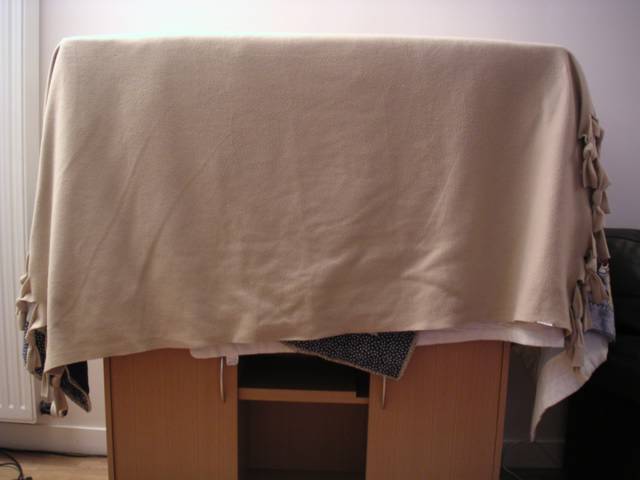
I started with the easiest way and least expensive: off lighting and blankets on the aquarium for a few days of complete darkness.


07/11/2004: 9 weeks after the impoundment.

09/11/2004: after two days of carbon filtration.

14/11/2004: full black

17/11/2004: a notable achievement

The result is visible after two days and a half: the fog has turned into a light mist. But difficult to continue any longer without risking damage plants or disturb my scales.

Treatment with Daphnia requires removing the fish, if the feast is a feast of algae daphnids. I'll try to cobble together a system that would protect these good workers (with a bottle and a sock filter) to see what it gives, even though this may diminish its effectiveness.

Remain UV appear to have a radical effect (see this thread on ForumAqua ). But for now I hate to buy a UV lamp to use it a few days. A follow

yet ...

PS: Thanks to Peter who guided me well on this problem and Nico offering me a plan for a loan of UV lamp.

whole story:
- J + 9 weeks! cloudy water!
- Muddy Water (continued)
- Muddy Water (continued again ...)
- Muddy Water: end!

Saturday, November 13, 2004

What Mini Van Gets Best Milage

filtration and filter media

As explained in Article " Filtration: filters , all filters obey the same principle: the dirty water is taken from the tank, it passes through different filter materials properties and different roles, and finally it returns own in the tray.
The actual filtration work is performed by the filter media. Without them, the filter would only circulate water.

The different types of filtration: mechanical, biological and chemical

The filter media will retain waste ( mechanical filtration ), treat the water by bacteria (biological filtration ), and retain or distribute certain substances (chemical filtration ).
Each type of filter has its usefulness and is directed by appropriate filter media.

Multiplicity and the relative shares of filter media

A filter material can often be two or three actions (mechanical, biological and chemical).
is the dominating action which will be retained and which will be operated by appropriate positioning in the filter. The same filter material placed at various locations will not necessarily share the same casting.
Moreover, the casting choice of action will be made with respect to those of other filter media. Imagine the mass A good stock mechanical and biological, and mass B in good mechanical and biological action in very good: in this case the mass A will be dedicated to the mechanical action and mass B to the biological action. These reasons

(multiplicity and relativity of action) explain the apparent inconsistencies that imputes the neophyte: what is true in a case is not necessarily in another.

Mechanical filtration

Mechanical filtration is designed to retain particles or undissolved solids suspended in water.

It is performed by filter media acting as nets or porous materials. The particles are retained by two effects: either the particle is larger than the "mesh" of the filtering and is therefore blocked (or surface filtration media) or it is smaller than the "mesh" of mass filter but it will be blocked by getting lost in the maze formed by the filtering and impact against a surface encountered (effect depth or wall).
In practice, this second effect is most often at work.

particles are retained, they accumulate in the body and eventually the seal: the water does not pass (and it's even faster than the surface effect is at work). It needs to be cleaned regularly these media.

To avoid clogging too fast and too frequent cleanings, it is advisable to use in the direction of flow of water masses with "mesh" large, medium and fine: the maximum particle will be retained and clogging will be delayed.

The filter media used for mechanical filtration are: cotton, Perlon (such as cotton wool but with a synthetic material instead of cotton), mosses, some ceramics (to be first to hold the waste very large), etc..

Biological filtration

Biological filtration is designed to treat certain substances by bacteria. This is mainly to implement the nitrification of the nitrogen cycle that will convert the ammonia / ammonium to nitrite and nitrate.

This filtration will be done by filter media that will provide good support to the proliferation of bacterial colonies, while allowing water to circulate around and therefore the necessary oxygen.

This party does not dirty its operation: substances produced (nitrate) start with water. Instead, it should never have to clean this part, because cleaning will be disastrous for the bacterial colonies, which could cause an imbalance in the nitrogen cycle.
The water entering the biological part should be as clean as possible which is why it is always placed after the mechanical filtration.

The filter media used for biological filtration are: ceramics with high porosity, foams, very porous substrates such as pozzolan, etc.. In contrast, cotton and Perlon are low bacterial support.

Chemical filtration

Chemical filtration is intended to retain some dissolved substances in a material according to the physico-chemical properties. We also classify in this category of substances released by a material (eg peat humic acid release).

be found in this part of the coal (incorrectly said to be active), resins (anti-phosphate anti-nitrate, etc.) and many so-called miracle products. Their action decreases with time because they "meet" with the substances they hold.

Generally, these products must be used wisely and never for prolonged periods (except peat), because often there are long-term adverse effects.

Organization of filtration and filter media

In the classical case of compact filters internal or external and internal decantation, must establish the mechanical and biological filtration, and optionally, if necessary, chemical.

The order relative to the direction of flow of water (up and down have no meaning here) will be: mechanical filtration and biological filtration and finally, possibly, chemical filtration.

If the filter is small, we must focus on mechanical filtration while still trying to dedicate a game to biological filtration.

More on this organization in the article "Filtration: an example of organization of the filter" (forthcoming).

See also " Filtration: filters .
Friday, November 12, 2004

Do The 2nd Cervical Caner Jabs Hurt

Filtration: filters

Filtration is essential to balance the tray and without it we should change the water almost every day. The filter is just the kidney of the tank: it will recycle and purify water in the tank. But unlike a kidney, there is no waste disposal: it must be done by hand during filter maintenance. Body
Living the aquarium, the filter should not be stopped beyond a few hours. The principle


filters All filters obey the same principle: the water is removed, it passes through different filter materials properties and different roles, which will retain the wastes (mechanical filtration), treated with bacteria (biological filtration), retain or disseminate certain substances (chemical filtration) and finally back into the water tank.

Different types of filters

There are several types of filters, which have their advantages and disadvantages. They are internal (in the tray) or external (outside the tank). It may be mentioned in the internal compact internal filter, settling internal filter exhauster the undergravel filter, and external compact external filter, settling external semi-wet the filter, filter runoff, filter fluidised sand bed.

In general, an aquarium comes with one of the following three filters: compact internal filter, settling internal or external compact filter.
The compact internal and external filters are similar: they consist mainly of a chamber filled with filter media through which a pump will circulate the water. The internal versions are to be reserved for small tanks (up to 100 liters) and external versions for large bins (from 100 liters). The internal
decantation tanks in pack (or type Juwel Ferplast) resemble finally an internal filter, but with a chamber into several compartments. The name actually seems inappropriate in this case and it is more of a variety of internal filters.


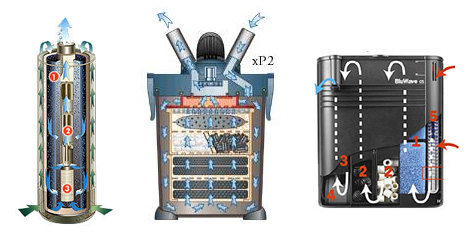
Examples of internal and external filters (Rena) and settling internal (Ferplast)

Other types of filters are to be reserved for the aquarist confirmed magnet experiment.

Which filter to choose?

Let your tank comes with a filter and you can use it at least to start if it is correct and sufficient, or you need to choose your equipment.

The best compromise is the compact external filter : ease of use and maintenance, high power and importance of chamber size and cons risk (almost nil) leaks.
compact internal filter is less aesthetic, limited in volume and less simple maintenance. The settling internal
packs seems more appealing because compact all-in-one, but eventually it shows its limitations in size and maintenance.

The filter is characterized by speed are schedule, in liters per hour. It is recommended to take a hourly rate of about 3 times the tank volume (eg 600 l / h for a tank of 200 l). In practice, the actual throughput will be lower: resistance of filter material, length and cleanliness of pipes, etc.. For a tank with big polluters (like goldfish, cichlids or) it can take up to 5 times. Needless to
too powerful: it will create too much turmoil and may interfere with some fish. Be sure to break the flow of rejection in this case.

The filter is a vital organ of your aquarium. Do not bad economies: take filter properly sized and a recognized brand . The brand seems Eheim acclaimed, but other brands have correct products: Rena , Hagen, JBL, etc..

To continue:
- filtration and filter media
- Filtration: an example of organization of the filter (to come)